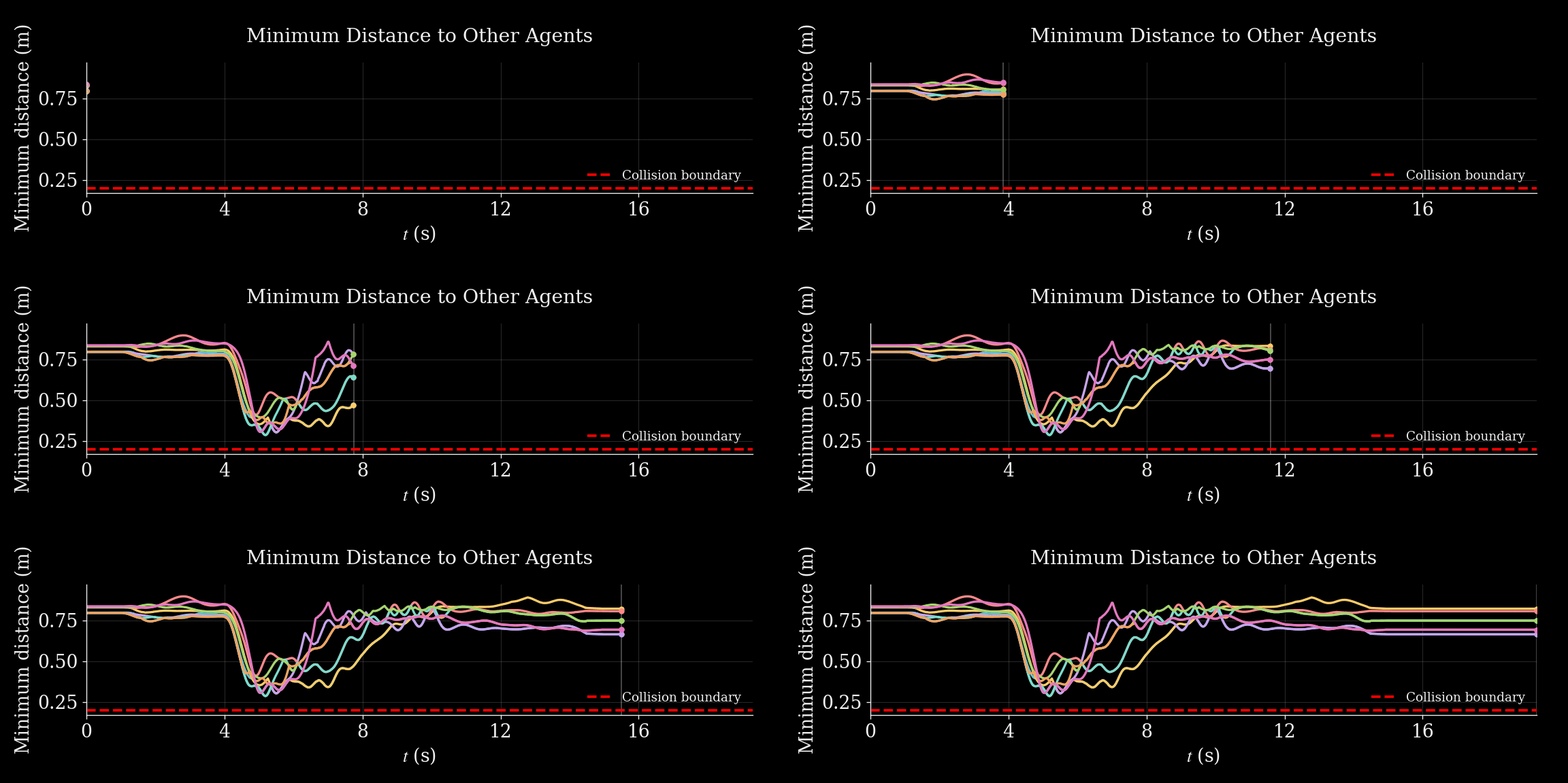
Safe and scalable control of large multi-robot systems (MRS) remains challenging under local sensing and limited actuation. Existing learning-based approaches commonly rely on gradient-based optimization of the current policy to generate pointwise data for supervision, providing limited coverage of the coupled interactions that can arise over finite horizons. We introduce Graph Barrier Diffusion (GBDiff), a framework that combines model-based diffusion with graph barrier certificates to reason about finite-horizon, actuator-constrained multi-robot interactions. GBDiff performs sampling-based optimization over joint control sequences and propagates the sampled controls through the system dynamics, while jointly evaluating interactions among neighboring robots, to generate diverse, dynamically feasible, and actuator-constrained trajectories. These trajectories are used to learn graph barrier certificates and distill diffusion-guided coordination modes into a distributed, safety-aware policy. Diffusion is used only during training, enabling efficient distributed execution without iterative sampling. Simulations across multi-robot systems of increasing dynamical complexity, including high-dimensional, non-control-affine F-16s, together with hardware experiments involving Crazyflie position exchange, demonstrate improved safety, task performance, and scalability relative to existing methods.
During training, graph-coupled model-based diffusion samples finite-horizon control sequences under system dynamics and actuator limits, guided by safety and goal-reaching objectives. These sequences supervise a graph barrier function and a shared distributed policy, enabling control from local graph observations without online diffusion sampling.
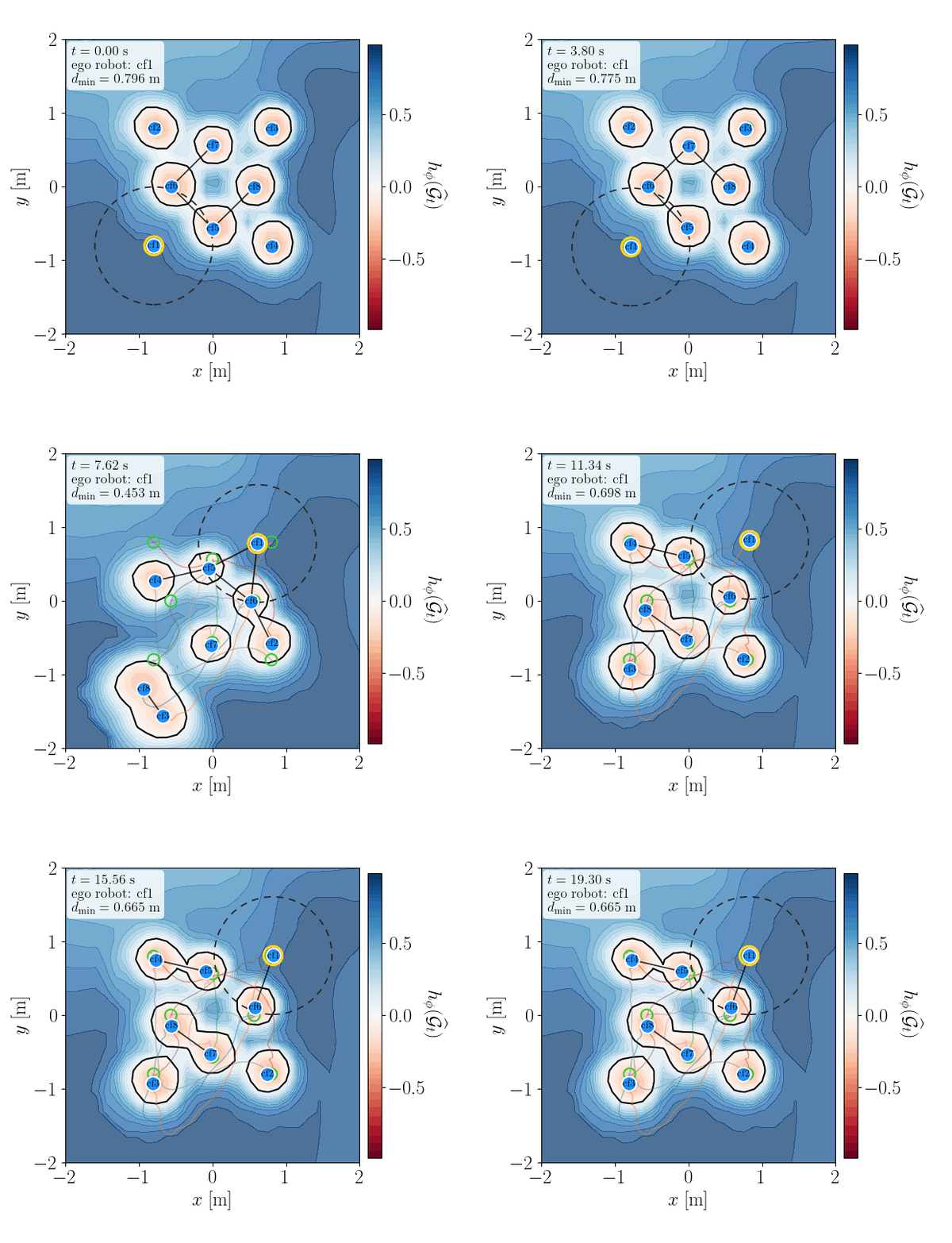
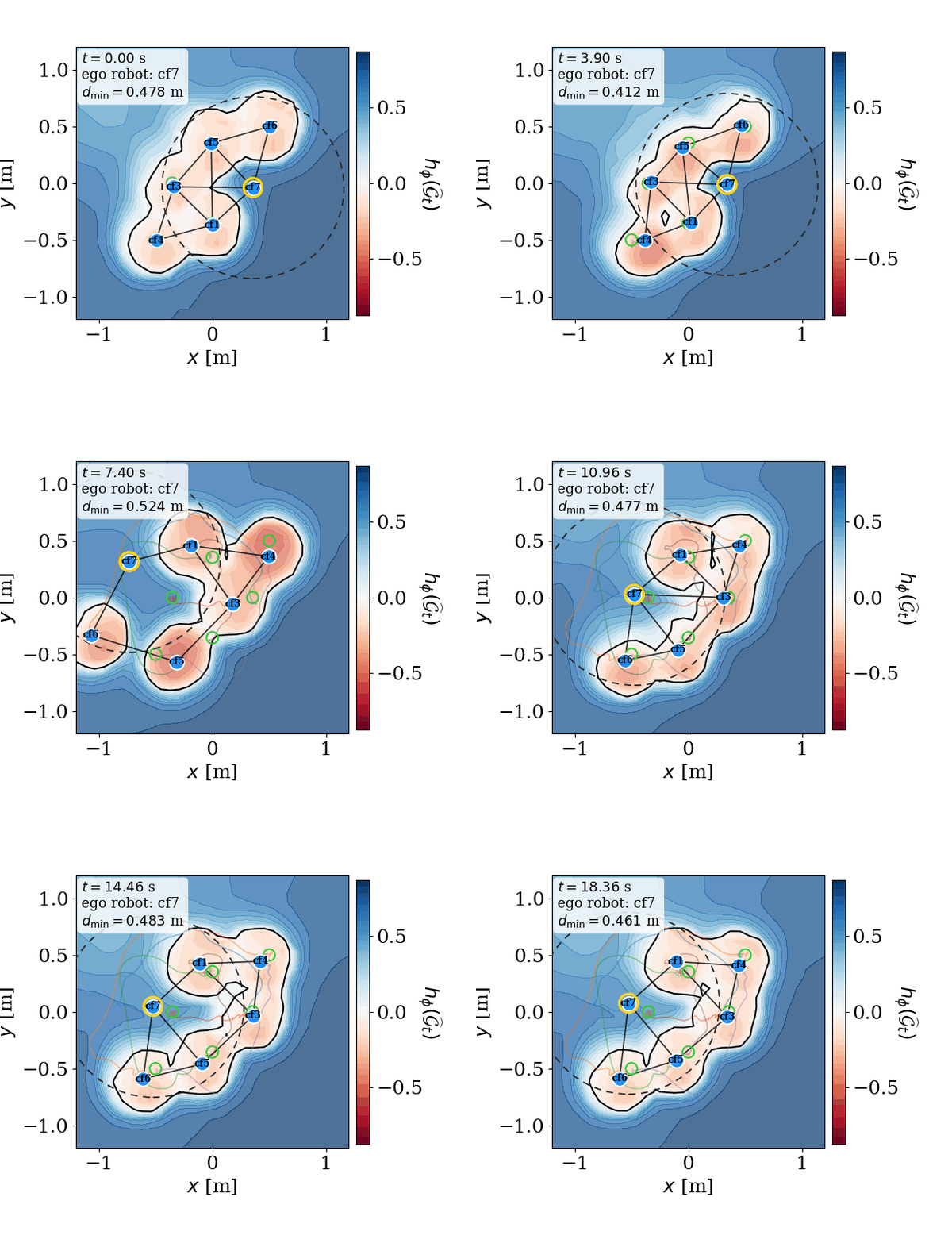
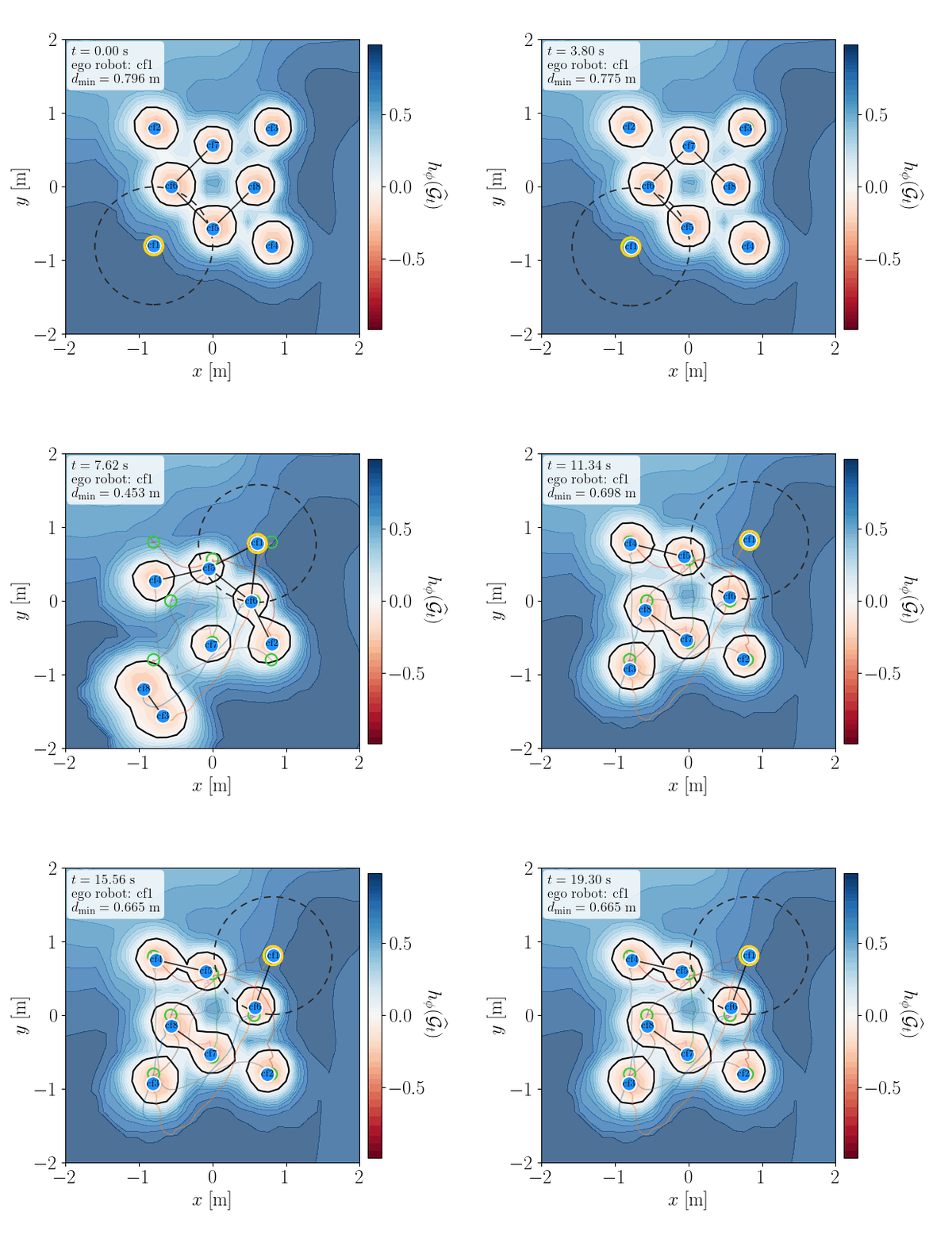
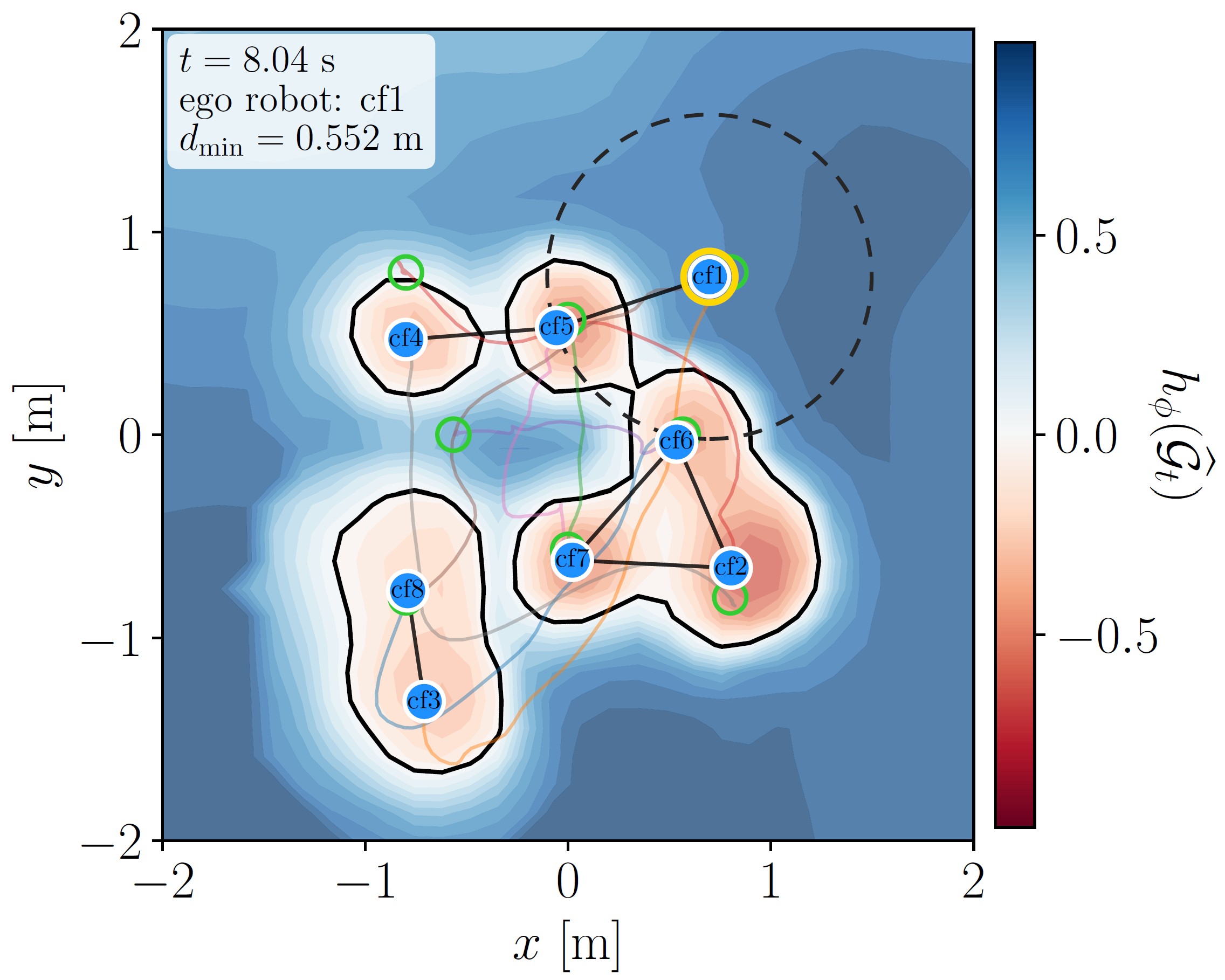
Learned graph barrier contours during Crazyflie hardware execution. Left: A snapshot of the local barrier landscape Right: Its evolution during hardware execution under the distributed policy.
Four F-16 aircraft navigate a constrained low-altitude corridor using the GBDiff distributed policy. The policy learns to minimally modify nominal formation-control commands to promote collision avoidance while preserving formation. The task requires at least 100 ft obstacle clearance and at least 200 ft inter-aircraft separation, with altitude maintained between 500 and 1,500 ft above ground and bank angles limited to ±45°.
Six Crazyflies perform a coordinated position-exchange task using a GBDiff policy trained in simulation with six robots. The policy transfers directly to hardware without fine-tuning, computing control commands from local graph observations without online diffusion sampling or centralized coordination.
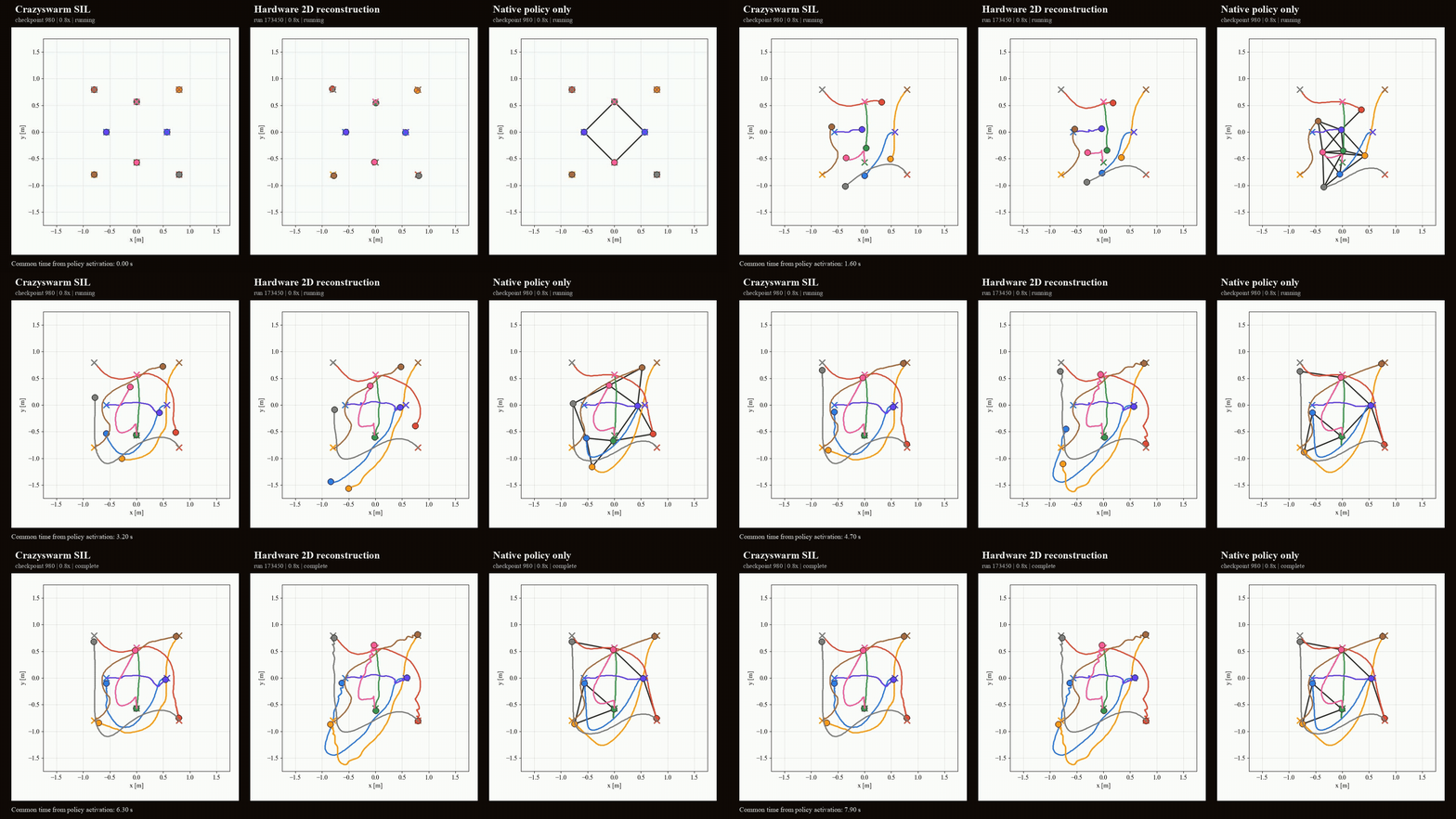
Eight Crazyflies execute a position-exchange task using the GBDiff policy trained for 6 robots without hardware fine-tuning. Each robot acts on local graph observations, coordinating with its neighbors while maintaining inter-robot separation, without online diffusion sampling.
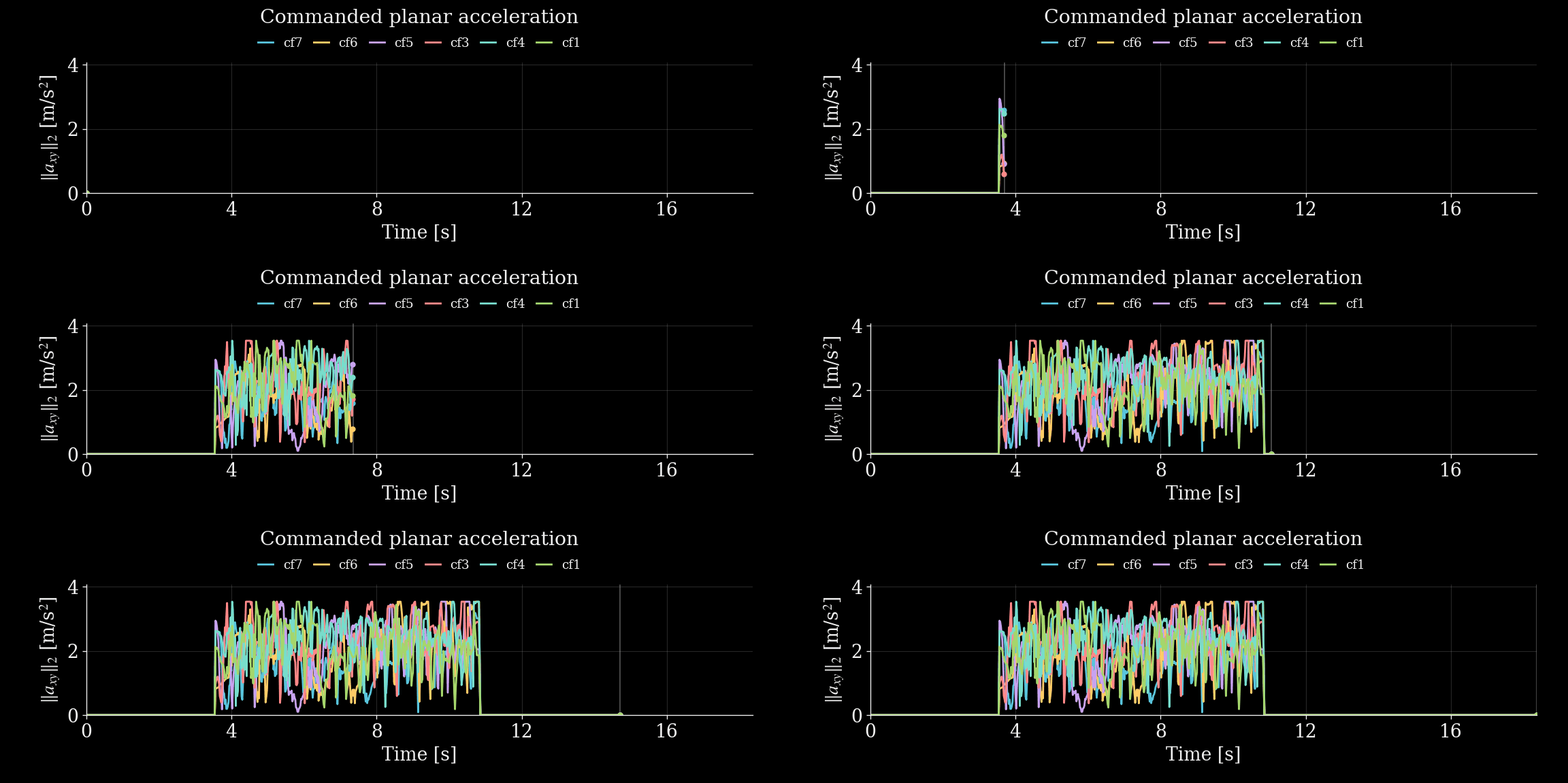
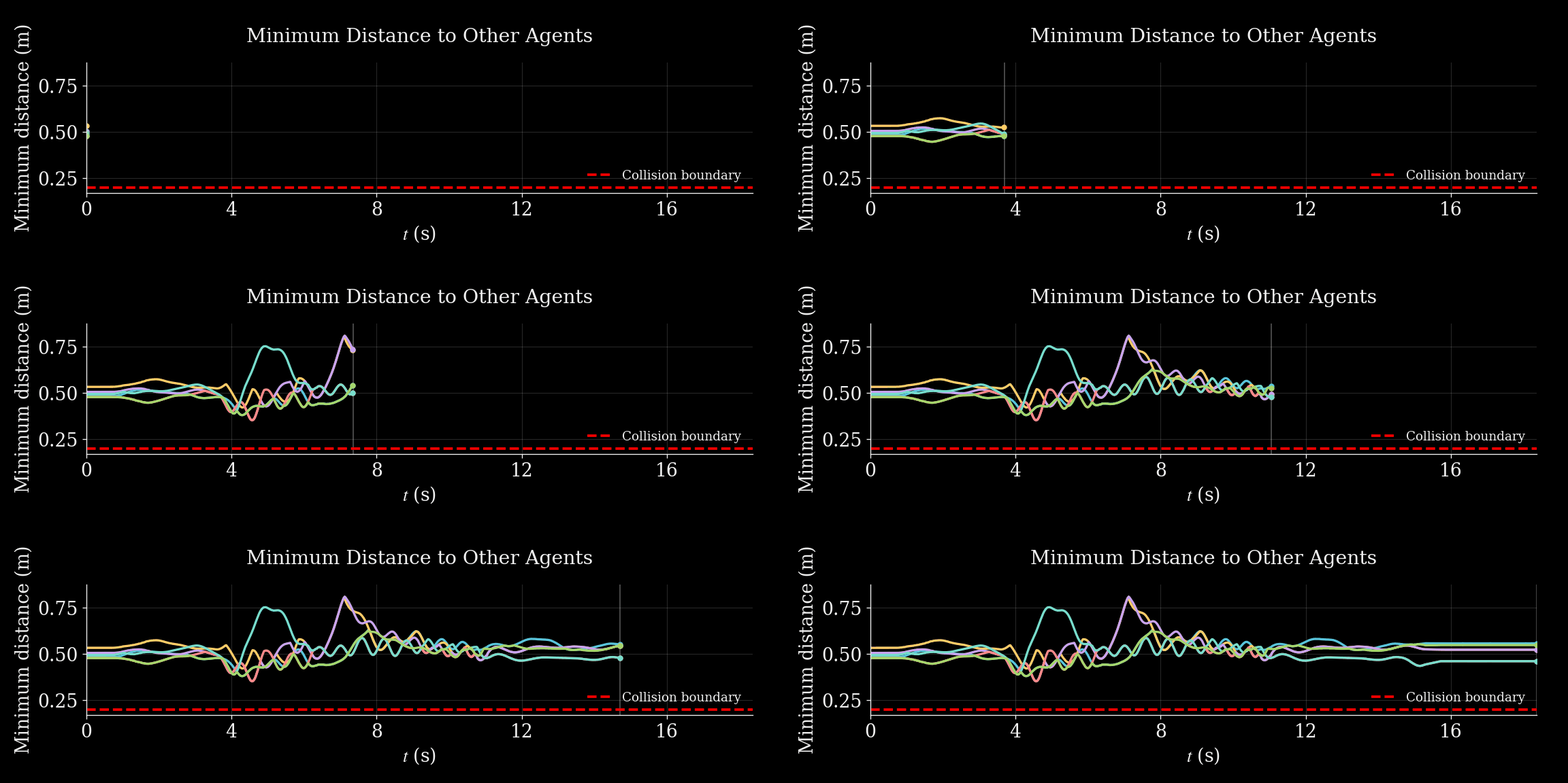
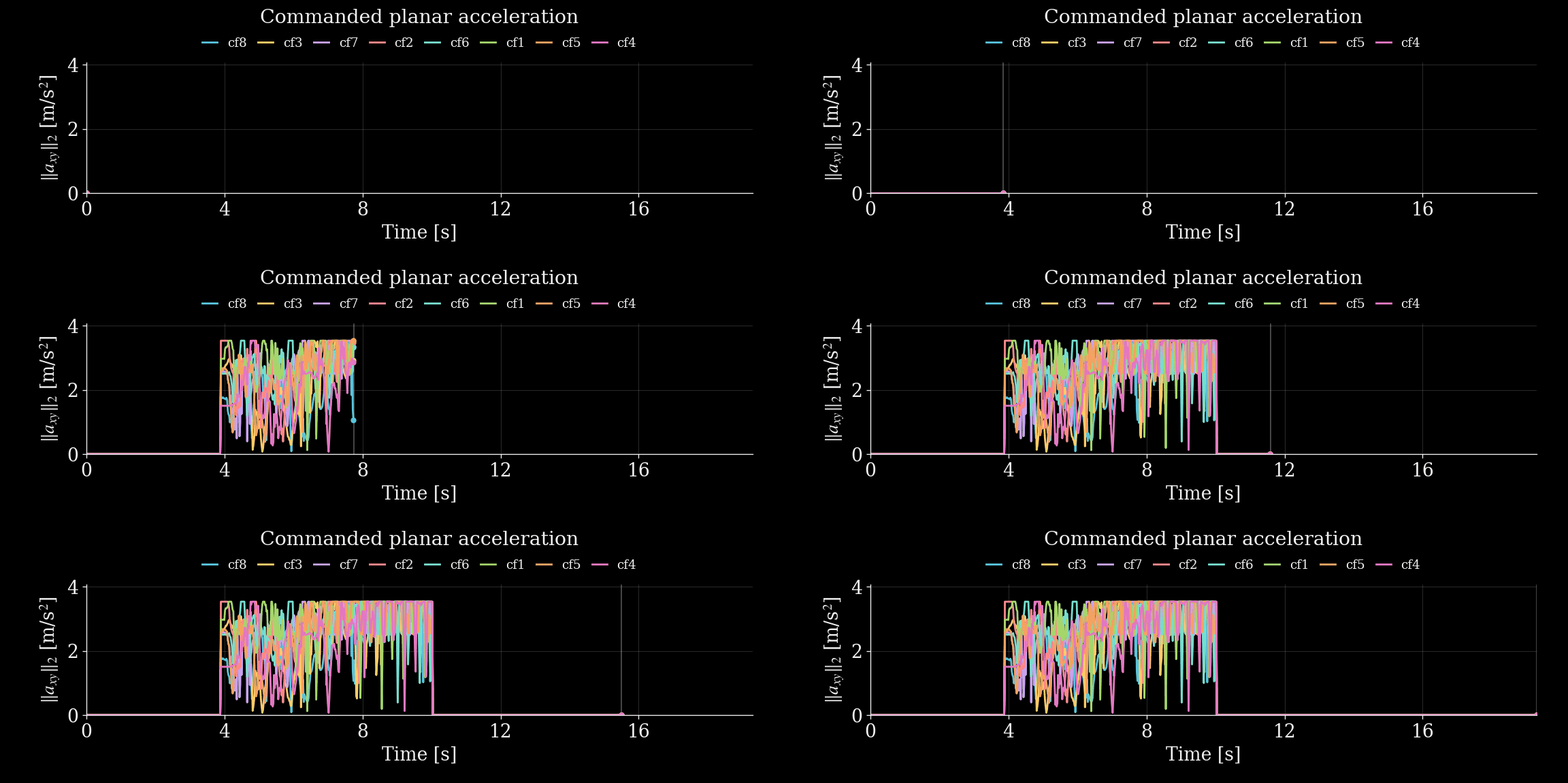
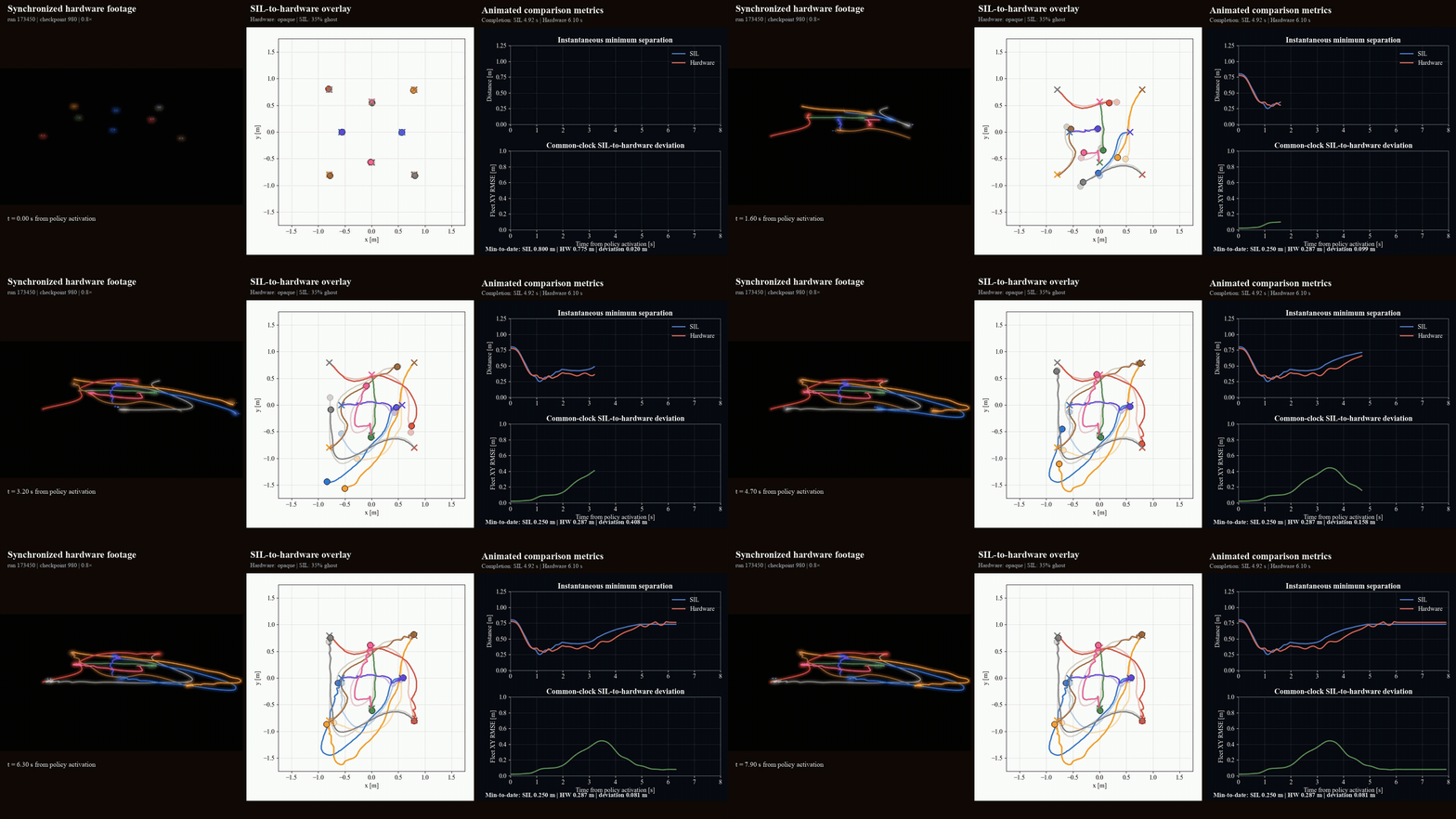
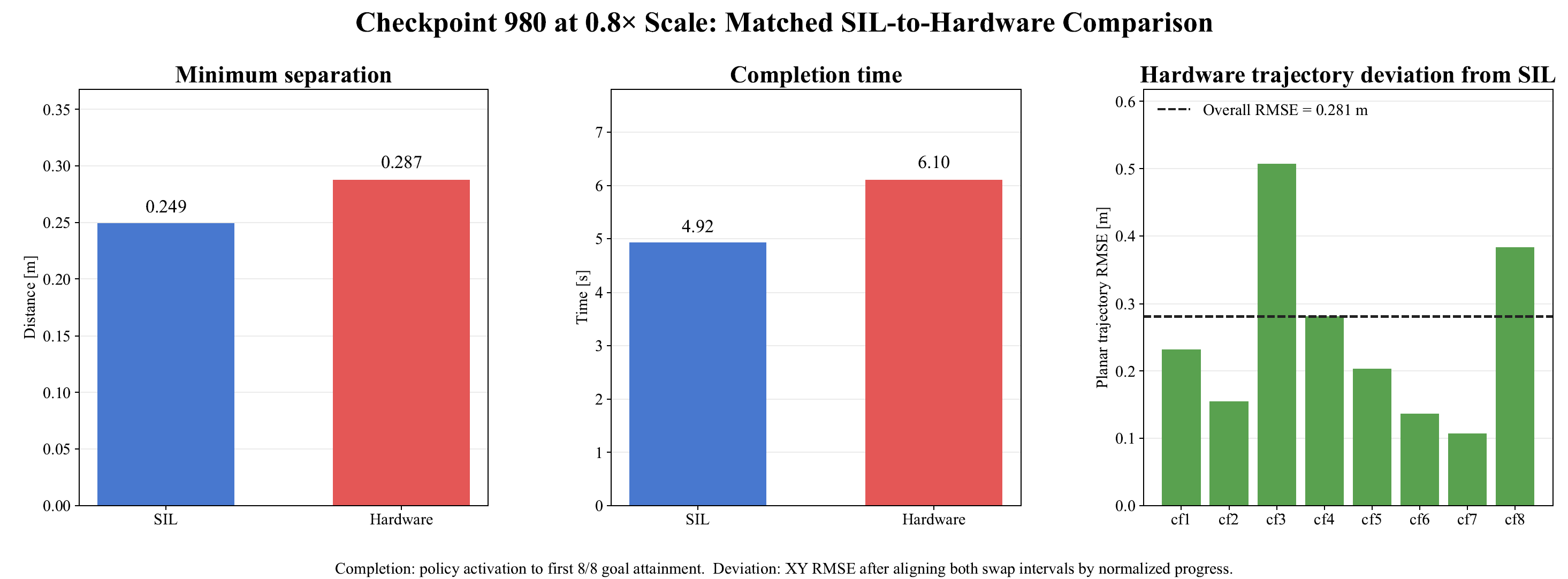
Comparison of the same GBDiff policy in software-in-the-loop (SIL) simulation and hardware for 8 crazyflies. Trajectories are synchronized from policy activation to compare coordination behavior, minimum inter-robot separation, completion time, and simulation-to-hardware trajectory deviation.
The policy was trained in simulation and deployed directly on Crazyflie hardware without additional training or parameter adaptation. Despite simulation-to-hardware trajectory deviations, the policy successfully completed the task, demonstrating zero-shot simulation-to-real transfer.
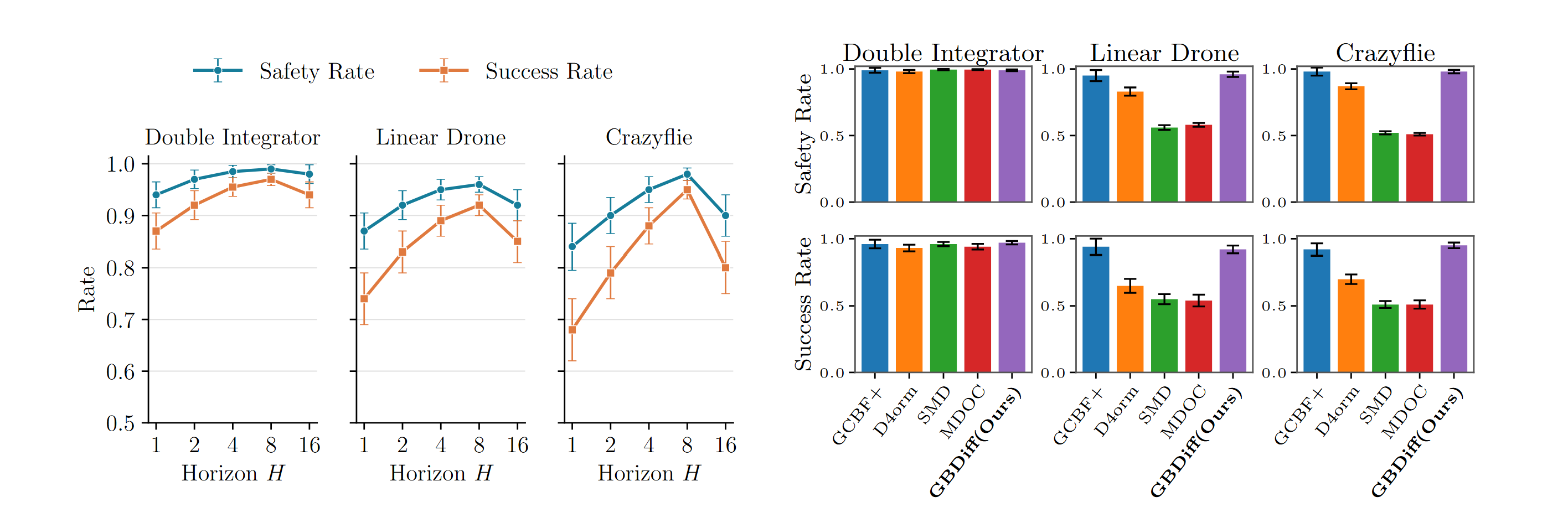
Safety and success rates across Double Integrator, Linear Drone, and Crazyflie benchmarks with eight robots and four obstacles. We examine the effect of the diffusion horizon and compare GBDiff with existing methods.
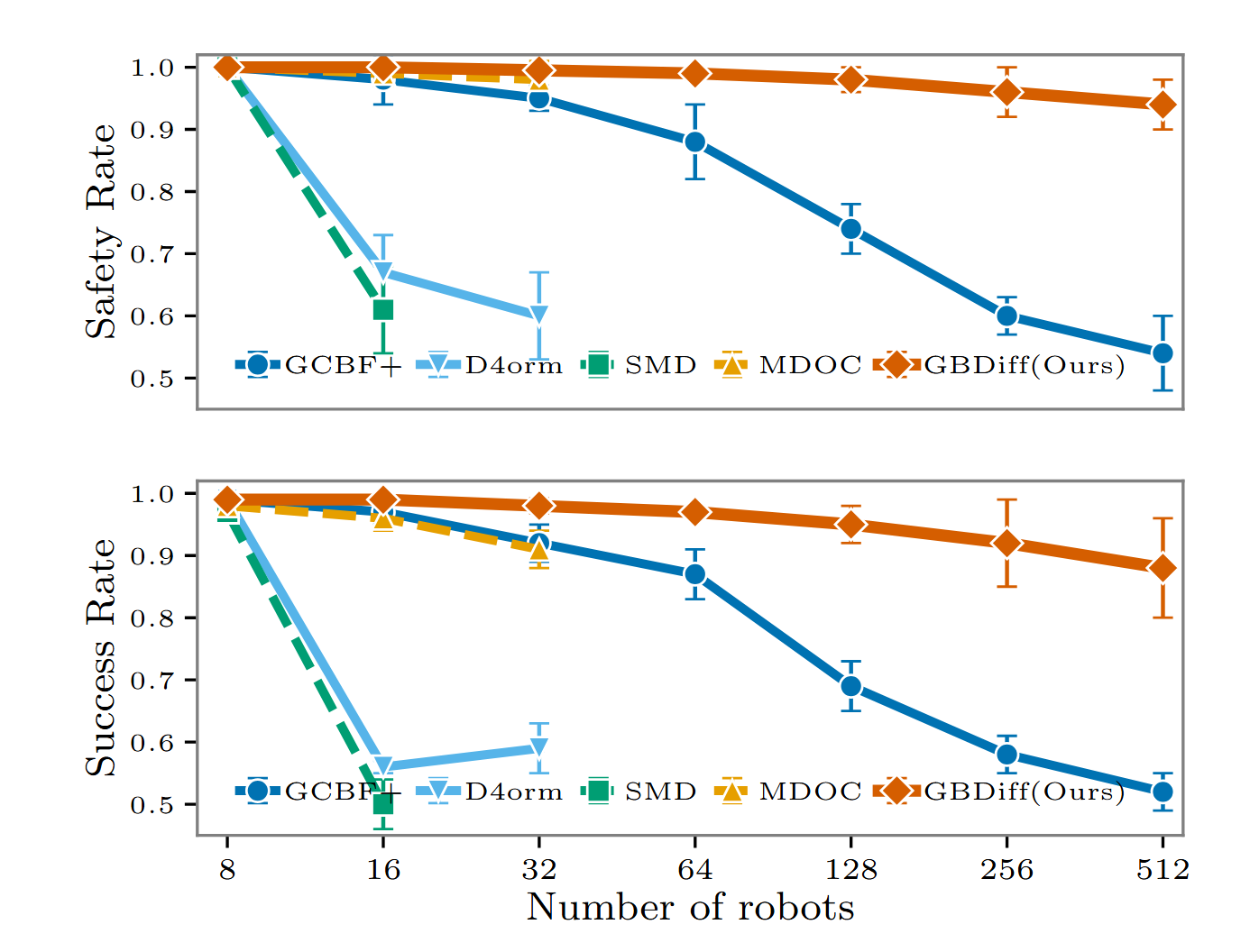
Trained with eight Crazyflies in obstacle-free simulation, the graph barrier and distributed policy are evaluated without retraining on teams of up to 512 robots. Missing baseline points indicate that the prescribed computation-time or memory budget was exceeded.